Over the past few months, one word seems to be appearing everywhere in business conversations.
On the surface, tariffs might feel like a technical economic topic. Something that mainly affects governments, global trade and large corporations.
But the interesting thing about uncertainty in the global economy is that it rarely stays confined to boardrooms or policy debates. It filters down into everyday decision making.
You start to see it in businesses delaying investment. Consumers hesitating before making purchases. Teams questioning whether plans will still go ahead.
Uncertainty changes how people think and behave.
And when you look at it through the lens of behavioural science, the reasons become much clearer.
Why uncertainty changes our behaviour
Our brains are wired to protect us.
When the environment around us becomes unpredictable, we naturally become more cautious. The focus shifts from pursuing opportunity to avoiding potential loss.
This is where several behavioural biases begin to surface much more strongly during periods like this.
1. Loss Aversion
One of the most powerful behavioural biases is loss aversion.
Put simply, the pain of losing something is typically felt far more strongly than the pleasure of gaining something of equal value.
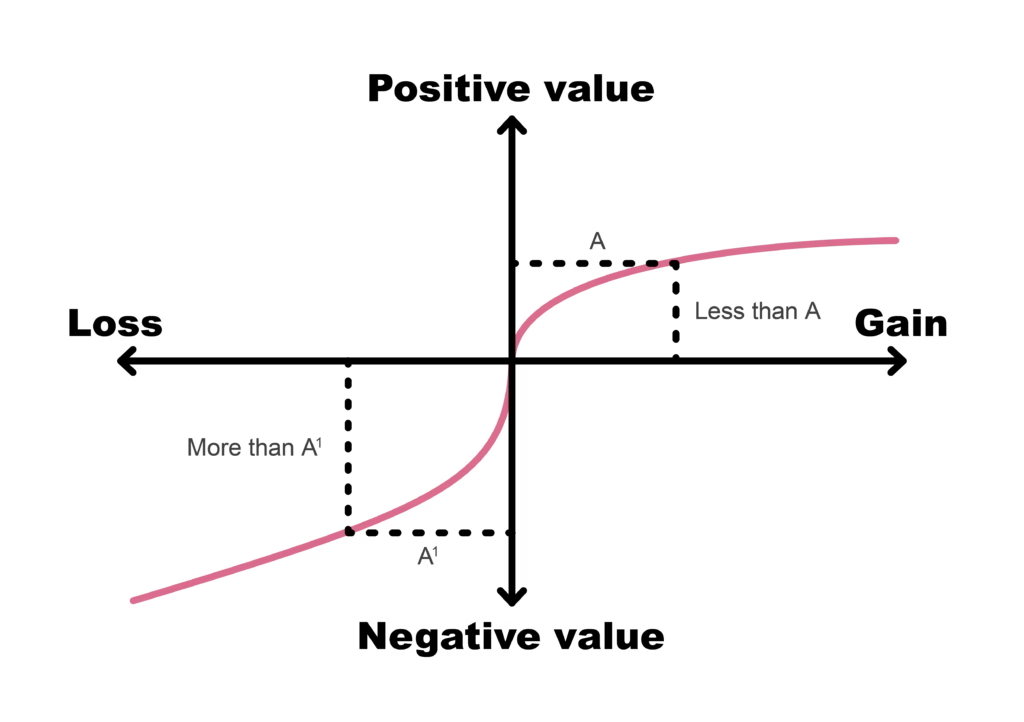
When uncertainty increases, that sensitivity to potential loss becomes even stronger.
How this plays out is businesses hold back investment, consumers delay spending. Decisions that might have felt comfortable a few months earlier suddenly feel riskier.
2. Status Quo Bias
Another common reaction to uncertainty is the amplification of status quo bias.
When people are unsure about the consequences of a decision, they often choose the safest option available: doing nothing. After all, no decision is a great guard against making a mistake.
It’s why people stick with the current supplier even when better alternatives exist. Or why businesses delay strategic decisions until the landscape becomes clearer.
Because staying where we are simply feels safer than moving into the unknown.
3. Ambiguity Aversion
A third bias that becomes particularly visible in uncertain times is ambiguity aversion.
Which is when the outcomes of a decision are unclear, we instinctively lean away from action. If the rules of the game feel unpredictable, people prefer to wait rather than risk making the wrong move.
How this shows up in everyday decisions
With the tariff talks fluctuating daily we’re seeing these behaviours appearing everywhere.
A business delaying a new product launch, a company holding back on hiring or a consumer putting off a large purchase because they want to “see what happens”.
None of these decisions are necessarily irrational. They’re simply the result of our brains trying to protect us from potential downside.
But there’s an interesting consequence, when large numbers of people all become cautious at the same time, progress slows down. On a mass scale.
What this means for brands
For businesses, understanding this psychological environment is incredibly important. During uncertain times, customers often need something different from the brands they engage with.
They need:
- Clarity
- Reassurance
- Transparency
When people feel uncertain, complicated messaging or aggressive selling tends to have the opposite effect. It increases hesitation rather than reducing it.
Instead, the brands that perform well in these environments are usually the ones that make decision making easier. They simplify information, communicate honestly and they focus on helping customers feel confident in the choices they’re making.
Opportunity in uncertain times
Interestingly, uncertainty can also create opportunity.
When many organisations become cautious and slow down their decision making, those who are willing to act with clarity and confidence often stand out even more.
That doesn’t mean taking reckless risks. But it does mean recognising when fear of loss is quietly driving too many decisions.
Sometimes the organisations that move forward thoughtfully while others stand still are the ones that create the biggest breakthroughs, utilising a less competitive moment.
🧠 A thought for you
Whenever you find yourself hesitating over an important decision, it can be useful to pause and ask a simple question.
Am I delaying this because of evidence, or because of uncertainty?
There’s a big difference.
Evidence-based caution is sensible, in many cases essential.
But decisions driven purely by ambiguity or fear can often hold us back more than we realise. And when we understand the behavioural forces at play, we give ourselves a much better chance of navigating uncertainty with clarity, confidence and conviction.

In this episode of The Customer Experience Lab , we explore the friction that stops people from doing what they say they want to do.
🎧 Listen on Apple Podcasts
🎧 Listen on Spotify
🎧 Listen on Amazon Music