Every January, millions of people set ambitious goals.
Eat better. Exercise more. Read more books. Learn a new skill.
And I’m not immune to this, ‘January 1st Si’ is a force to be reckoned with.
Yet, within a few weeks, many of those resolutions quietly fade away.
It’s not because people lack motivation or discipline. There’s actually a powerful psychological force at work behind the scene, the good old status quo bias. Once you understand it, you start to see it everywhere in life and business.
Why we prefer things to stay the same
Status quo bias is our natural tendency to stick with what we already know rather than move towards something new. Even when the alternative might objectively be better.
At first glance this can look like laziness or resistance to change. But in reality it’s rooted much deeper in how our brains process risk and uncertainty.
Behavioural economists like Daniel Kahneman and Richard Thaler have shown that people tend to value what they already have more highly than something new. At the same time, the pain of losing something familiar often feels stronger than the potential benefit of gaining something better.

So when we’re faced with change, our brains instinctively lean towards safety.
The psychology of inertia
There’s a useful way to think about this.
Newton’s first law of motion tells us that an object at rest will remain at rest unless acted upon by an external force.
Human behaviour works in a surprisingly similar way. Once routines and habits are established, they create a kind of psychological inertia. Changing them requires energy, attention and a willingness to tolerate uncertainty.
That’s why those January goals often start strong, the new year creates a moment that feels like a fresh start (The Fresh Start Effect).
But as the weeks pass, familiar routines quietly pull us back into old patterns.
How Status Quo Bias shows up in consumer behaviour
This bias doesn’t just influence personal habits. It plays a huge role in how customers behave.
It’s one of the reasons people stay with the same bank for years, even when better options exist. Or why someone continues using familiar software rather than switching to a new platform that might actually be more efficient. Or why when you’ve got an iPhone or Android switching really isn’t an option.
Comfort and familiarity are powerful forces. If adopting a new product or service feels complicated or uncertain, most people will default to what they already know.
Even large brands have stumbled because they underestimated this.
The famous 1985 New Coke launch is a classic example. In blind taste tests many people preferred the new formula, yet when Coca-Cola replaced the original recipe, customers reacted strongly and demanded the old version back. It took just 79 days to reverse the decision and bring back the ‘old Coke’
The product itself wasn’t the problem. It was the disruption of something people felt emotionally attached to. Reassuring that a marketing powerhouse can make these mistakes too.
Helping people move beyond the Status Quo
Understanding status quo bias doesn’t mean change is impossible. It just means we need to design experiences that make change feel easier.
There are a few practical ways to do this.
1.Reduce friction
The easier it is for someone to move to a new option, the more likely they are to do it.
Complicated onboarding processes, unclear instructions or too many steps can quickly push people back towards the familiar. So strip out complexity and make it as easy as possible.
2. Focus on benefits, not just features
When people are considering change, they’re not just comparing functionality. They’re weighing risk. Clearly communicating the positive outcomes of switching can help shift that balance.
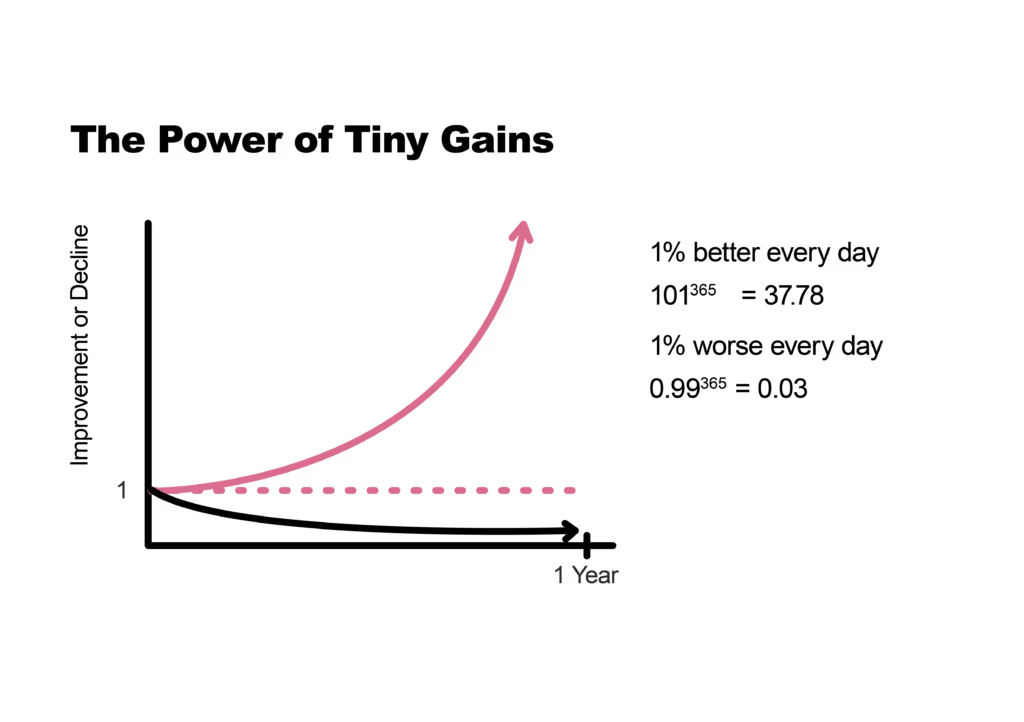
3. Start with small wins
James Clear talks about this beautifully in Atomic Habits. Small improvements build momentum. When change feels manageable, people are far more willing to take the first step.
4. Curate Choices
Too many options can actually increase hesitation, it’s called the Paradox of Choice. By simplifying choices and presenting clear recommendations, brands can reduce the mental load on customers.
5. Use Natural Moments for Change
Certain moments naturally make people more open to change. The Fresh Start Effect kicks in at these points in time. The start of a new year. A new job. A new home. Even the beginning of a new week.
These moments create psychological permission to try something different.
🧠 A thought for you
If customers seem reluctant to adopt something new, it’s easy to assume they’re simply resistant. But more often than not, they’re responding to deeply ingrained psychological patterns.
Status quo bias is incredibly powerful, but it’s not immovable.
When you design experiences that reduce friction, build confidence and gently guide people forward, change becomes much easier.
Remember the goal isn’t to push people out of their comfort zone. It’s to create a path where taking the next step simply feels natural for them.

In this episode of The Customer Experience Lab , we explore the friction that stops people from doing what they say they want to do.
🎧 Listen on Apple Podcasts
🎧 Listen on Spotify
🎧 Listen on Amazon Music